
This is part two of the Gaming Stats blog where I will be looking at Dota 2 (Defense of the Ancients), a MOBA (Multiplayer online battle arena) game. See part 1 for Maplestory.
Part 2:


Dota 2 is a widely known free-to-play online game which has a solid base of fervent followers. To give you an idea, the last international Dota tournament (The International 5, or TI5) had a prize pool of $18 million with the first place being worth $6,634,661. Imagine a 16-year-old professional player becoming millionaire in an instant! (that was Suma1l from the Evil Geniuses team)
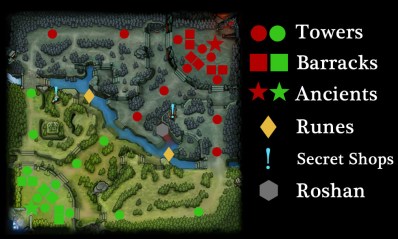
Source: The Layman’s Guide to Dota2
Dota 2 has one of the most complex gameplays for a MOBA, if not THE most complex. The goal of the game is basically to destroy the opposing team’s main structure; in Dota’s case, the Ancient. Each player controls one hero. Dota is played 5 vs. 5 heroes, so teamwork is crucial. Each team occupies half the map, and towers are positioned to defend the territory. To help heroes push to victory, allied “creeps” (minions) spawn every 30 seconds and automatically attack enemy towers, barracks and the Ancient. Heroes level up with experience from enemy creep and hero kills, allowing players to allocate points to skills. Heroes also get gold with time and from “last hitting” enemy and neutral creeps, from destroying enemy towers, from bounty runes, and from killing Roshan and enemy heroes.
The game dynamics are very complicated. Here are some of the things to keep in mind when playing:
- There are more than 100 heroes to choose from, often with unconventional abilities apart from the usual damage-dealing blows, stuns and slows: skills like swapping positions with the enemy, becoming invisible, being able to teleport anywhere on the map, setting traps that can be detonated remotely, or copying an enemy hero’s ability. This unusual diversity makes every Dota match unique as different hero team combos can make completely different gameplays. An example of a two-hero combo is one with Bloodseeker (can target a hero to both deal and take extra damage) and Zeus (can strike damage to all enemy heroes wherever they are).
- The aspect of denying is also very important: a hero can kill his own team’s creeps and destroy his own tower to “deny” the enemy their experience
- When a hero is killed, they not only have to wait to respawn, but they also lose some of their gold. A skilled Dota player would make sure to spend all of their gold on items before they die so as to minimize losses
- Item choice can enhance a hero’s build. There are not only passive items to improve hero stats, but also items to heal, reduce skill cooldowns, teleport, slow enemies, hex enemies into a harmless critter, temporarily become immune to enemy skills, etc.
- The map itself has what is called “fog of war”: players cannot see past a certain distance unless an ally is there. They also cannot see behind trees and ground levels above them such as hills. This allows for interesting ambushing/fight-escaping moments.
Now, given the complexities involved, is there a way to crack the model using stats? Let’s see what is currently on the web…
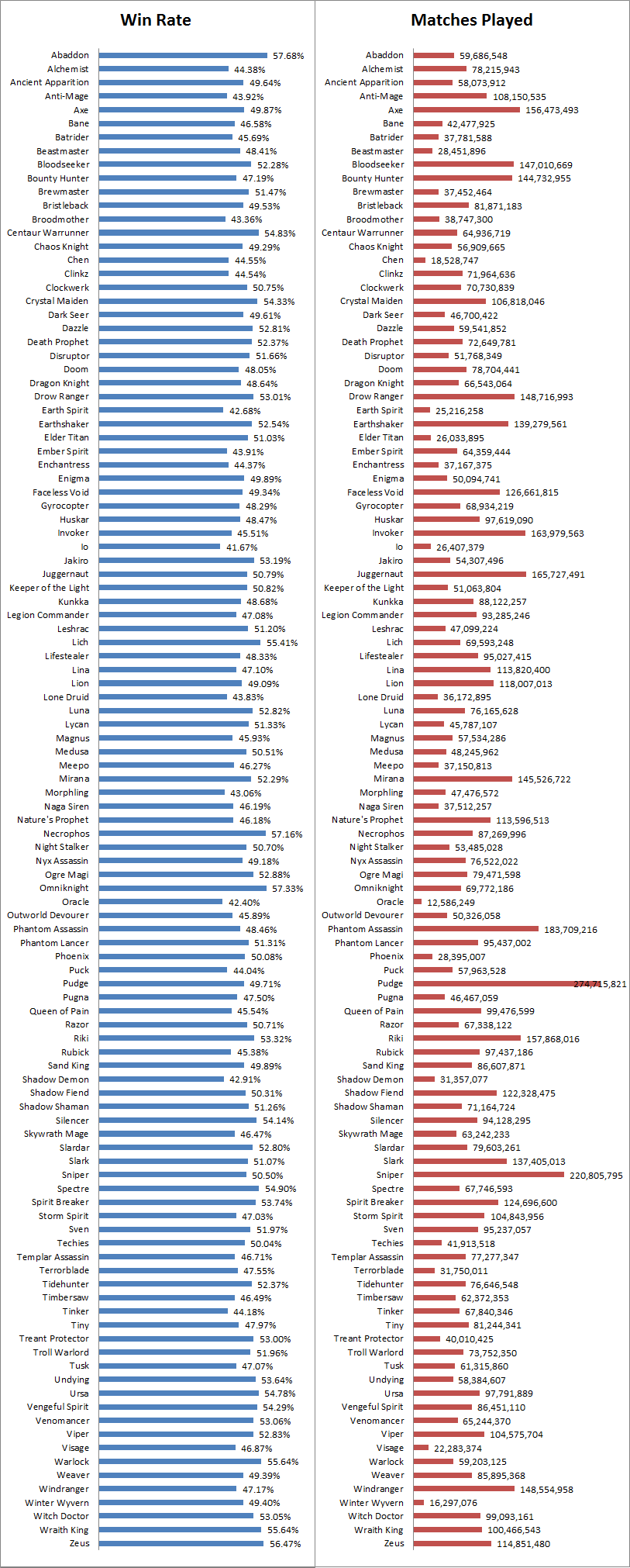
Source: Dotamax
These charts include all Dota 2 matches played to date, with ranked, normal and solo types, and with all types of skills from normal to tournament. The win rates hover toward 50% which suggests that the heroes are more or less balanced. Some of the heroes with the lowest win rates, such as Io, Earth Spirit and Lone Druid are among the most difficult to maneuver, while some like Oracle are just one of the newest heroes. Pudge is by far the most popularly played hero, likely because of his fun way of hiding in the trees and using his hook to pull unsuspecting enemies towards him to butcher them to their death. The second most played is the Sniper, in this case likely because he is easy to play with his long range and high damage shots, although he is vulnerable to close range attacks, which explains his 50% win rate.
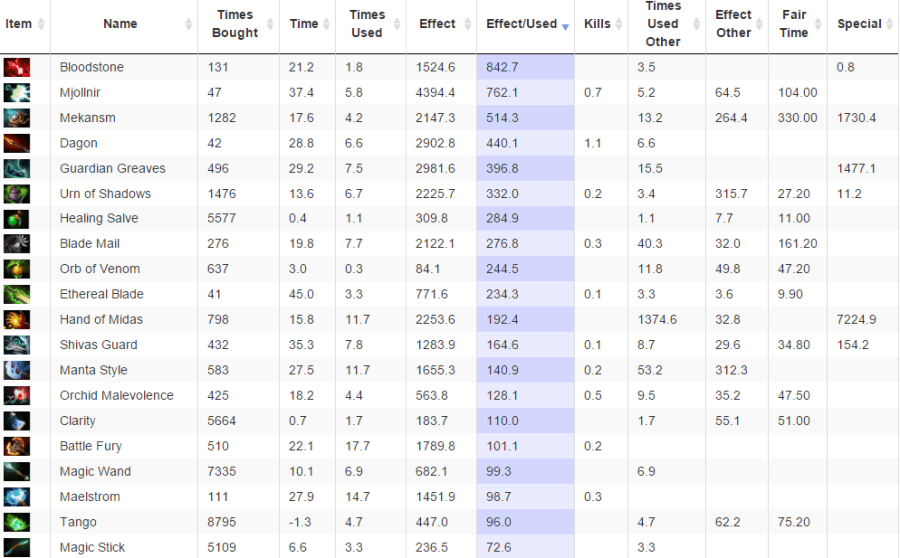
Source: datdota
Wonder which items are worth spending gold on? Here is a table of estimations of the most effective items per use in Dota 2 using data from 1080 games since the newest Patch 6.85. This includes mid-game items, and excludes items such as Aghanim’s Scepter or Black King Bar for which the effect was not measurable.

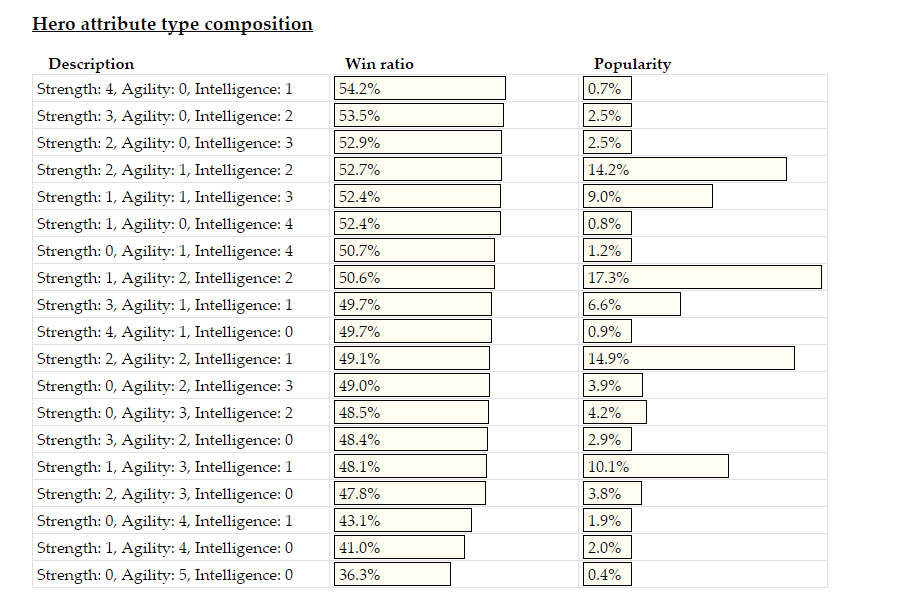
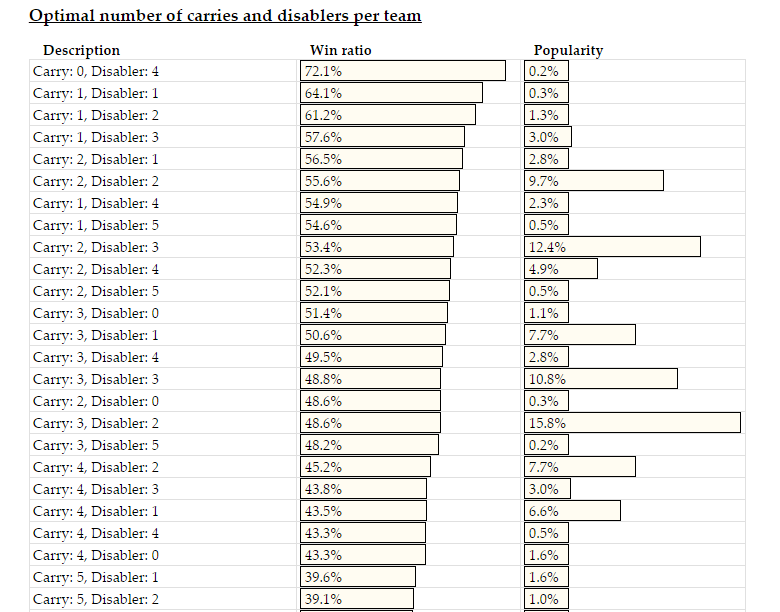
Source: Optimal Team Composition Statistics
Check out this outdated (2012) but nonetheless awesome analysis of the optimal team composition by KjellJagland from reddit using 39626 observations from Dotabuff. Popularity here is important as a low popularity might indicate outlier effects so we may want to take those with a grain of salt. Accounting for popularity, the analysis shows that the best teams have a balanced composition of melee and ranged heroes. Surprisingly, the analysis suggests that better results may be obtained with 5 ranged heroes — are Dota players having it wrong, or is it just the effect of outliers? Looking at the best performing teams by attributes, the model acknowledges the contribution of strength and intelligence-focused heroes — but surprisingly agility heroes do not seem so important in team composition. Lastly, not more than three carries seems to yield decent win rates and disablers seem to be especially important. Again, the teams with the highest win rates had no carry and 4 disablers, which is probably a fluke given the 0.2% popularity.
Finally, if you know about PCA analysis and logistic regression, check out this cool preliminary research paper here from Stanford as they, like KjellJagland, tried to find the predictive power of team compositions on win rates.
Final words: can we predict the outcome of a Dota match from the start of the game, i.e. just knowing the composition of the teams? Likely not; win rates are close, choice of items is sometimes crucial, and different choices can be determining such as warding in the proper places, farming in the lanes, spending time killing neutral creeps, or succeeding in killing Roshan to acquire the Aegis of the Immortal. But these stats do give an idea of how to improve players’ chances of winning.
 Wharton Undergraduate Statistics Society
Great article!
Like you mention, one interesting question how much are these correlations causative and how much do they reflect selection effects or even statistical artifacts? Notice that the most extreme ranged compositions, strength-heavy attribute builds, and disabler-heavy comps tend to do really well, but they’re also really, really rare – might it be possible that good players tend to favor these kind of builds? Or perhaps these results may partly be due to random chance? Could someone try some sort of statistical test on these statistics?
Also note that the preliminary paper is a CS229 (roughly equivalent to our CIS 520) final project, which is pretty cool!
LikeLiked by 1 person